
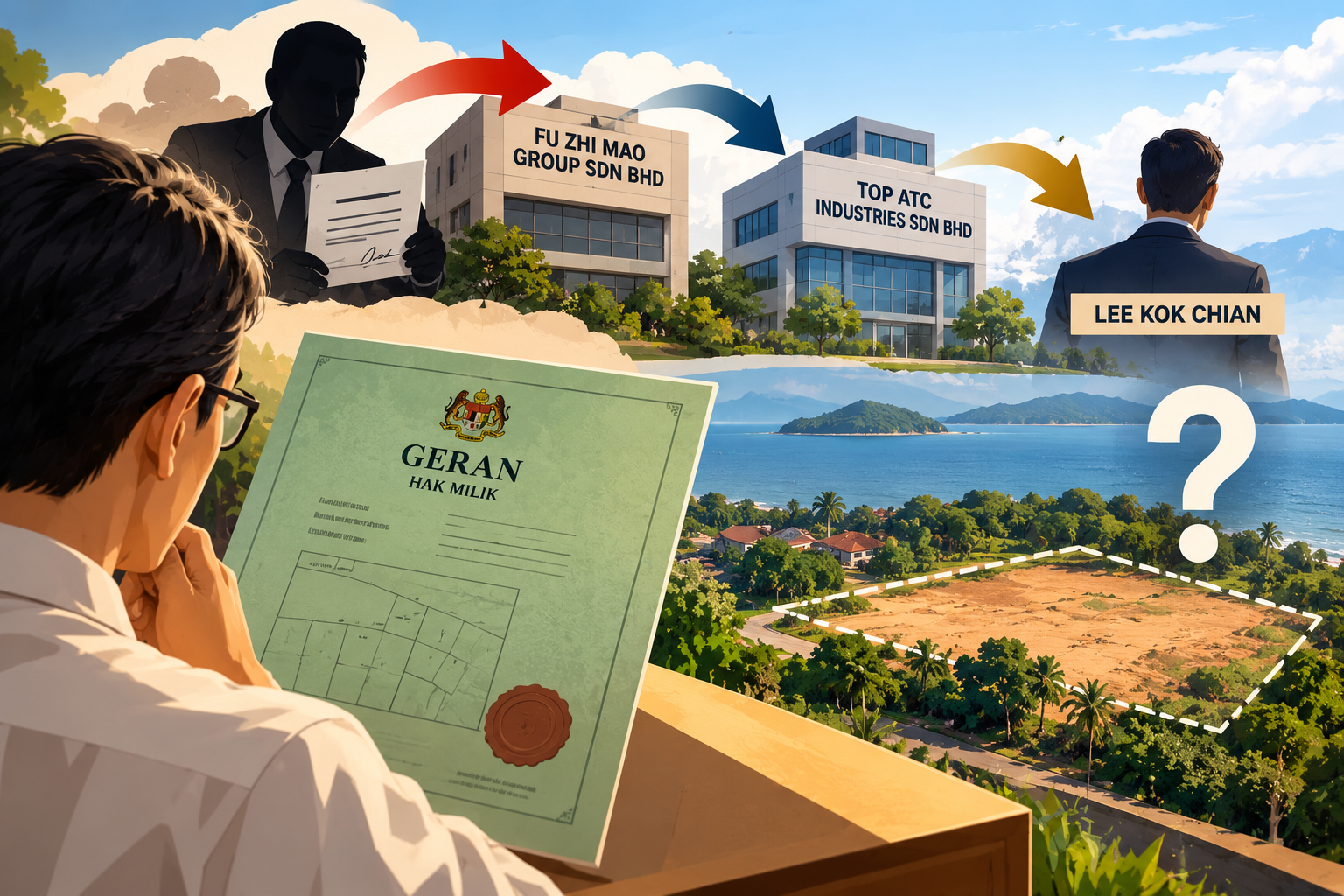
A Trustee’s Land Was Fraudulently Sold — Then Resold. Who Ultimately Owned It?
A Malaysian Court of Appeal case examining what happens when land held under a trust is fraudulently transferred and later resold to subsequent purchasers. The case explores fraud, forged documents, registered title, bona fide purchasers, due diligence and the circumstances in which a later buyer may lose the land.
Case Study · 11 min read · 7 Oct 2026
Imagine discovering that land held under a family trust has been transferred without the trustee's knowledge.
The trustee still has the original issue document of title.
The trustee never authorised the sale. Yet the land is now registered in someone else's name.
Then it is sold again.
And again.
By the time the original trustee takes the matter to court, the person whose name appears on the title is several transactions removed from the original fraud.
So who owns the land?
And can a later buyer say: “I bought it from the registered owner. My name is now on the title, so the land is mine.”
The Malaysian Court of Appeal considered precisely this type of dispute in Lee Kok Chian & Anor v Cheok Lam Chuan & Another Appeal, a case involving a parcel of land in Port Dickson, Negeri Sembilan.
The decision provides an important lesson about what happens when fraudulent land transfers are followed by subsequent sales to people who were not themselves involved in the original fraud.
The Land Was Held Under a Trust
The disputed property was Geran 159176, Lot 14182, Pekan Lukut, Daerah Port Dickson, Negeri Sembilan.
Cheok Lam Chuan and the late Cheok Yit Tuck were the registered owners of the land.
But they held it as trustees pursuant to a Declaration of Trust dated 24 May 1982, which had been registered with the relevant Land Office.
There was another important detail.
Cheok Lam Chuan continued to hold the original issue document of title for the land.
That meant the subsequent transfer of the land was not the result of a normal transaction authorised by the trustee.
According to Cheok's case, someone had managed to use his identity to make the transfer appear legitimate.
The Land Was Fraudulently Transferred
The land was transferred to Fu Zhi Mao Group Sdn Bhd, the first defendant.
The transfer involved an imposter using Cheok's identity, a forged instrument and a fake title.
The Court of Appeal noted that judgment in default had already been entered against the first three defendants before the trial.
As a result, fraud had been established against those defendants for the purposes of the proceedings.
But the fraudulent transfer was only the beginning of the dispute.
The land did not remain with the first recipient.
It was subsequently transferred to Top ATC Industries Sdn Bhd.
Top ATC then transferred the land to Lee Kok Chian.
The chain therefore looked like this:
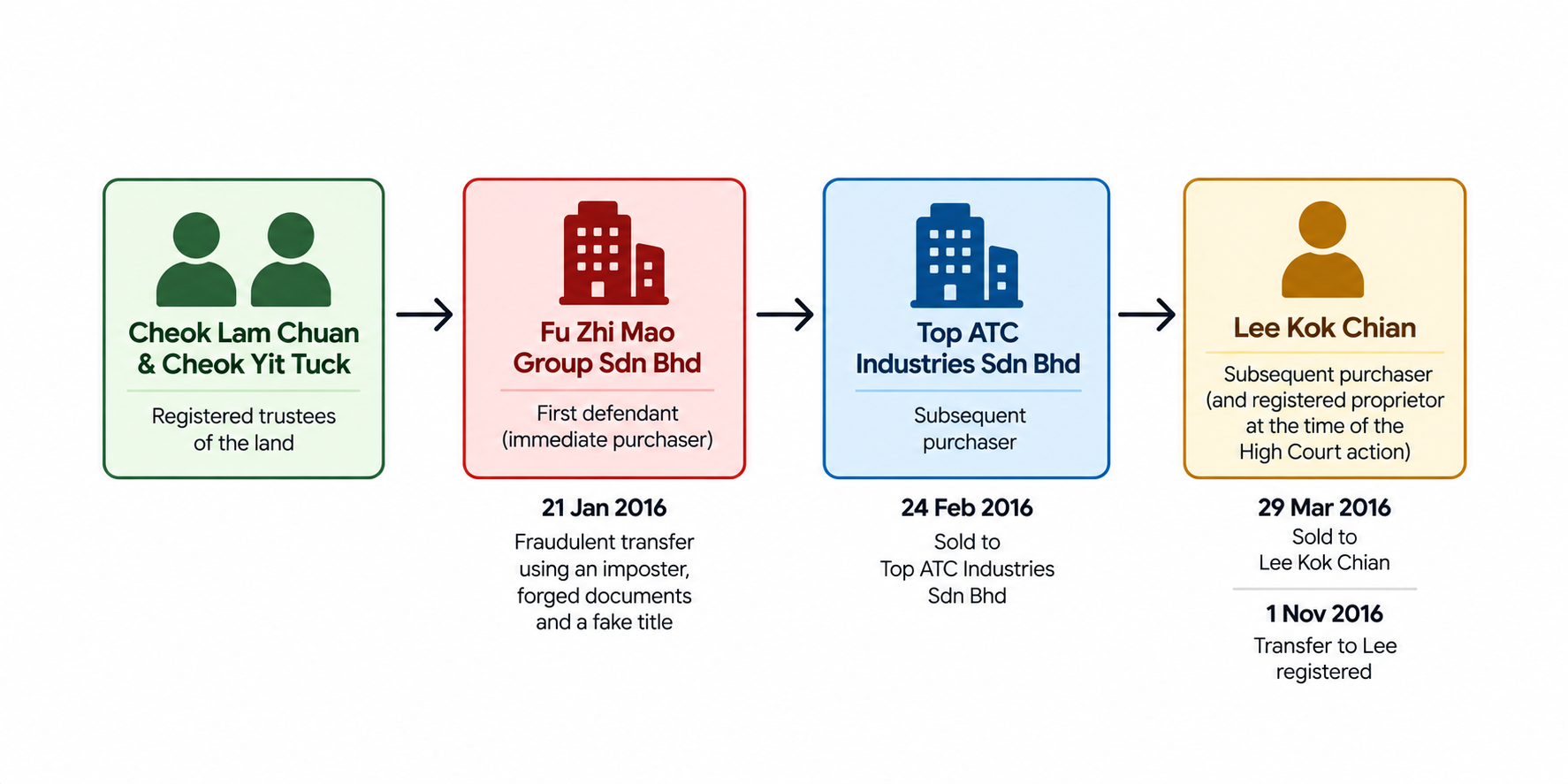
When Cheok brought the High Court action, Lee was the registered proprietor.
The Real Question: What Happens to the Later Buyers?
The case would have been relatively straightforward if the person who committed the fraud was still holding the land.
But that was not what happened.
Top ATC and Lee were later purchasers.
They argued, in substance, that they should receive the protection available to subsequent purchasers under section 340 of the National Land Code.
This raised several questions for the court:
- Were Top ATC and Lee immediate or subsequent purchasers?
- Were they bona fide purchasers for valuable consideration?
- Could they obtain an indefeasible title despite the original fraudulent transfer?
- Had they carried out sufficient due diligence before buying the property?
- What significance should be given to the unusually rapid sequence of transactions?
- Could Cheok recover the land even though someone else was now the registered proprietor?
The Court of Appeal had to examine each of these issues rather than simply asking whether fraud had occurred.
Issue 1: Who Was the Immediate Purchaser?
The Court of Appeal distinguished between the person who received the land directly from the fraudulent transaction and those who acquired it later.
The first defendant, Fu Zhi Mao Group, was the immediate purchaser.
Top ATC and Lee were subsequent purchasers.
This distinction mattered because section 340 of the National Land Code treats subsequent purchasers differently when considering whether registered title can be protected despite an earlier fraud.
But being a subsequent purchaser did not automatically settle the case in their favour.
They still had to establish that they qualified for the protection they were claiming.
Issue 2: Were the Later Buyers Genuine Purchasers?
This became the central issue.
Top ATC and Lee needed to establish that they were bona fide purchasers for valuable consideration.
The Court of Appeal was not satisfied that they had done so.
One of the major problems was the speed at which the property moved between parties.
The fraudulent transfer occurred on 21 January 2016.
The property was then sold by the first defendant to Top ATC on 24 February 2016.
Top ATC subsequently entered into another sale and purchase agreement with Lee on 29 March 2016.
The eventual transfer to Lee was registered on 1 November 2016.
The court considered the circumstances surrounding this rapid chain of transactions.
The issue was not simply: “Did Lee personally commit the original fraud?”
He did not.
The question was whether the circumstances were such that he could genuinely claim to have purchased the property in good faith.
Issue 3: Was There Credible Evidence That the Purchase Price Was Actually Paid?
The court also examined the evidence surrounding the payments.
For Top ATC, the court found that there was insufficient credible evidence to establish that the claimed substantial cash payment for the property had actually been made.
That was significant because a person seeking protection as a bona fide purchaser for valuable consideration must be able to establish the relevant purchase, not merely point to the fact that the transaction was eventually registered.
This is an important practical point for property transactions.
A buyer should not assume that registration alone will answer every question about how the property was acquired.
Documentation matters. Evidence of payment matters. The circumstances surrounding the transaction matter.
Issue 4: What Did Lee Know — and What Should He Have Checked?
Lee was further removed from the original fraudulent transaction.
But the Court of Appeal still examined whether the circumstances surrounding his purchase should have prompted further investigation.
The court found that the short period between the earlier transactions raised red flags.
The circumstances required more than simply accepting the transaction at face value.
The Court of Appeal concluded that the later purchasers had failed to establish that they were bona fide purchasers, pointing to the suspicious timing and the lack of credible evidence concerning substantial payments.
This is where the case becomes particularly relevant to ordinary property buyers.
Being a later buyer does not necessarily mean being an innocent buyer.
A purchaser who encounters unusual circumstances may need to ask questions and carry out appropriate due diligence.
What Does “Bona Fide Purchaser” Actually Mean?
In simple terms, a bona fide purchaser for valuable consideration is a purchaser who acquired the property genuinely and for value, without circumstances that deprive them of the protection the law gives to an innocent subsequent purchaser.
It does not mean: “My name is on the title, therefore I am automatically protected.”
The court looks at the circumstances surrounding the acquisition.
In this case, the Court of Appeal found that the later purchasers had not established the necessary bona fide status.
So Who Got the Land?
This was ultimately the most important outcome.
The Court of Appeal dismissed the appeals on the substantive land ownership issue and upheld the High Court's decision that the land should be returned to Cheok Lam Chuan.
In other words, the later registered purchasers could not keep the property simply by relying on their registered title. The land was ordered to be re-registered in Cheok's name.
The court's decision demonstrates that registration is extremely important under Malaysian land law, but registration does not provide an unlimited shield where the statutory requirements for protection have not been satisfied.
But the Court Did Not Uphold Everything
There was another issue on appeal: aggravated damages.
The High Court had awarded aggravated damages to Cheok.
The Court of Appeal set that part of the award aside.
Its reasoning was that aggravated damages must be specifically pleaded and particularised. Cheok had not done so adequately in the statement of claim.
So the outcome was not simply:
Original owner wins → everything awarded by the High Court remains.
Instead, the Court of Appeal separated the issues.
On ownership: Cheok succeeded.
On the later purchasers' claim to bona fide purchaser protection: They failed.
On aggravated damages: The award was set aside.
That distinction is important when understanding what the court actually decided.
Why This Case Matters to Anyone Buying Land
The case raises a question that every property buyer should consider: Is checking the title enough?
A title search is essential.
But this case shows why a buyer should also pay attention to the circumstances surrounding the transaction.
Consider a situation where:
- the property has changed hands unusually quickly;
- the purchase price appears unusual;
- substantial payments are allegedly made in cash;
- supporting documents are incomplete;
- the seller's authority is unclear;
- the property is being sold shortly after another recent purchase; or
- something about the transaction simply does not make sense.
None of these things automatically proves fraud.
But they can be reasons to stop and investigate before completing the transaction.
What Should a Buyer Check?
Check the registered proprietor
Confirm who is actually registered as the owner.
Check the nature of the ownership
Is the owner acting personally, or as a trustee, executor, administrator or representative? The distinction matters.
Check the transaction history
Where possible, understand how recently the property changed hands and whether there have been unusual successive transfers.
Verify the seller's authority
If a trustee or representative is selling the property, confirm that the person has the necessary authority to act.
Keep proper payment records
A purchaser should maintain clear documentary evidence showing the consideration paid for the property.
Investigate unusual circumstances
Do not ignore warning signs simply because the person selling the property appears to be the registered proprietor.
Obtain professional advice where necessary
A complicated title or suspicious transaction is not the time to rely solely on an informal assurance from the seller or agent.
The Bigger Lesson: Registration Is Not the End of Due Diligence
The most useful lesson from Lee Kok Chian is not that every fraudulent transfer will result in the original owner automatically recovering the land.
The case is more specific than that.
It shows that subsequent purchasers may have legal protection in appropriate circumstances, but they must satisfy the requirements for that protection.
Here, the Court of Appeal found that the circumstances surrounding the subsequent purchases—including the rapid sequence of transfers and insufficient evidence supporting the claimed consideration—prevented Top ATC and Lee from establishing that they were bona fide purchasers for value. Malaysian Judgment Digest
That ultimately meant that the original trustee was able to recover the land.
The TerraLink Takeaway
A registered title is important, but it is not a substitute for due diligence. If a property transaction contains warning signs, a buyer may need to investigate further before relying on the protection given to a bona fide purchaser.
The case is a powerful example of how a land fraud can become increasingly complicated:
- Trust property
- Impersonation and forged transfer
- First purchaser
- Rapid resale
- Second purchaser
- Dispute over registered title
- Court examines good faith and due diligence
- Land returned to the original trustee
For landowners, the lesson is to understand how your title is held and protect the underlying documents and records.
For buyers, the lesson is equally important:
Do not ask only, “Whose name is on the title?” Ask, “How did this person acquire the land, and is there anything about this transaction that I need to investigate?”
Case at a Glance
| Reference | Details |
|---|---|
| Case | Lee Kok Chian & Anor v Cheok Lam Chuan & Another Appeal |
| Citation | [2025] MLJU 2273 Court Court of Appeal, Putrajaya |
| Decision | 29 July 2025 |
| Appeal Nos. | N-01(NCVC)(W)-52-02/2023 & N-01(NCVC)(W)-56-02/2023 |
| High Court | High Court of Malaya at Seremban High Court |
| Suit | NA-21NCVC-8-11/2018 |
| Property | Geran 159176, Lot 14182, Pekan Lukut, Daerah Port Dickson, Negeri Sembilan |
| Key law | Section 340, National Land Code |
| Main issues | Fraudulent transfer, subsequent purchasers, bona fide purchaser for value, indefeasibility of title, due diligence |
| Final result | Appeals dismissed on the substantive ownership issue; land to be returned to Cheok Lam Chuan; aggravated damages award set aside |
Source: Court of Appeal judgment as indexed by Malaysian Judgment Digest and the reproduced judgment text. This article is for educational purposes and is not legal advice. The outcome of any particular land dispute depends on its own facts, title records, documents and applicable law.